The Rise and Decline of Nations by Mancur Olson
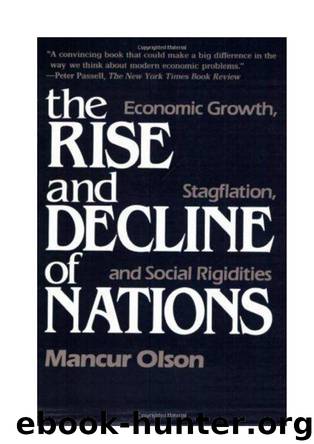
Author:Mancur Olson [Olson, Mancur]
Language: eng
Format: epub
Published: 0101-01-01T00:00:00+00:00
Although the textbooks explain the other reasons for liberal or internationalist policies,
such policies can draw additional support from the theory offered here, because free
trade and factor movement evade and undercut distributional coalitions. If there is free
international trade, there are international markets out of the control of any lobbies. The
way in which free trade undermines cartelization of firms, and indirectly also reduces
monopoly power in the labor market, has already been discussed. Free movement of
productive factors and firms is no less subversive of distributional coalitions. If local
entrepreneurs are free to sell equities without constraint to foreigners as well as to
borrow abroad, those with less wealth or inferior connections at home will be better able
to get the capital needed for competition with established firms, and may even be able to
marshall enough resources to break into collusive oligopolies of large firms in industries
where there are substantial economies of scale. If foreign or multinational firms are
welcome to enter a country to produce and compete on an equal basis with local firms,
they will not only often bring new ideas with them but also make the local market more
competitive and perhaps destroy a cartel as well. That is one reason why they are
usually so unpopular-the consumers who freely choose to buy their goods and the
workers who choose to accept the new jobs they offer do not lose from the entry of the
multinationals, but these consumers and workers may be persuaded that this foreign
entry is undesirable by the propaganda of those who do.
The resistance to labor mobility across national borders has a similar inspiration.
Whereas rapid and massive immigration obviously can generate social tensions and
other costs, these costs are not the only reason for the barriers against foreign labor. The
restrictions on immigration and guest workers in many countries and communities are
promoted mainly by special-interest organizations representing the groups of workers
who have to compete with the in-migrants; labor unions obtain limitations on the inflow
of manual workers, medical societies impose stricter qualifying examinations for foreign-
trained physicians, and so on. The separate states of the United States, for example, not
only control admission into most professions, but often also into such diverse occupations
as cosmetology, barbering, acupuncture, and lightning-rod salesmen. These controls are
frequently used to keep out practitioners from other states. The nations of Western
Europe also vary greatly in the proportion of migrants and guest workers they have
admitted. Many other factors are involved, but the initial impression is that countries
with weaker labor unions have accepted relatively larger inflows of labor.
Download
This site does not store any files on its server. We only index and link to content provided by other sites. Please contact the content providers to delete copyright contents if any and email us, we'll remove relevant links or contents immediately.
International Integration of the Brazilian Economy by Elias C. Grivoyannis(111322)
The Radium Girls by Kate Moore(12096)
Turbulence by E. J. Noyes(8129)
Nudge - Improving Decisions about Health, Wealth, and Happiness by Thaler Sunstein(7762)
The Black Swan by Nassim Nicholas Taleb(7200)
Rich Dad Poor Dad by Robert T. Kiyosaki(6728)
Pioneering Portfolio Management by David F. Swensen(6343)
Man-made Catastrophes and Risk Information Concealment by Dmitry Chernov & Didier Sornette(6144)
Zero to One by Peter Thiel(5874)
Secrecy World by Jake Bernstein(4805)
Millionaire: The Philanderer, Gambler, and Duelist Who Invented Modern Finance by Janet Gleeson(4540)
The Age of Surveillance Capitalism by Shoshana Zuboff(4355)
Skin in the Game by Nassim Nicholas Taleb(4310)
The Money Culture by Michael Lewis(4268)
Bullshit Jobs by David Graeber(4253)
Skin in the Game: Hidden Asymmetries in Daily Life by Nassim Nicholas Taleb(4052)
The Dhandho Investor by Mohnish Pabrai(3826)
The Wisdom of Finance by Mihir Desai(3795)
Blockchain Basics by Daniel Drescher(3643)
